
Sold As Choice, Built For Control: How Vouchers Are Cementing Christian Influence In America
In this article, I discuss private school voucher programs, their origins, and their motivations.

Separation of church and state. We treat it as a legal rule, but we often forget it’s also a practical necessity. At its core, democratic government is a science—an ongoing experiment. We pass policies, observe the results, and adjust based on the data. It’s a system built on the premise that we can learn from failure.
Religion operates on the opposite frequency. It’s not about hypothesis and observation; it’s about revelation and faith. This isn’t a criticism of faith, but a recognition of its incompatibility with governance. When you introduce absolute dogma into a system that requires flexibility and evidence, you break the machinery.
Sadly, we’re watching that machinery break in real time. The separation of church and state is being dismantled, not by a frontal assault, but through the backdoor of education policy. In this article, I want to discuss a primary vehicle for this dismantling: the private school voucher.
The Origins Of Private School Voucher Programs
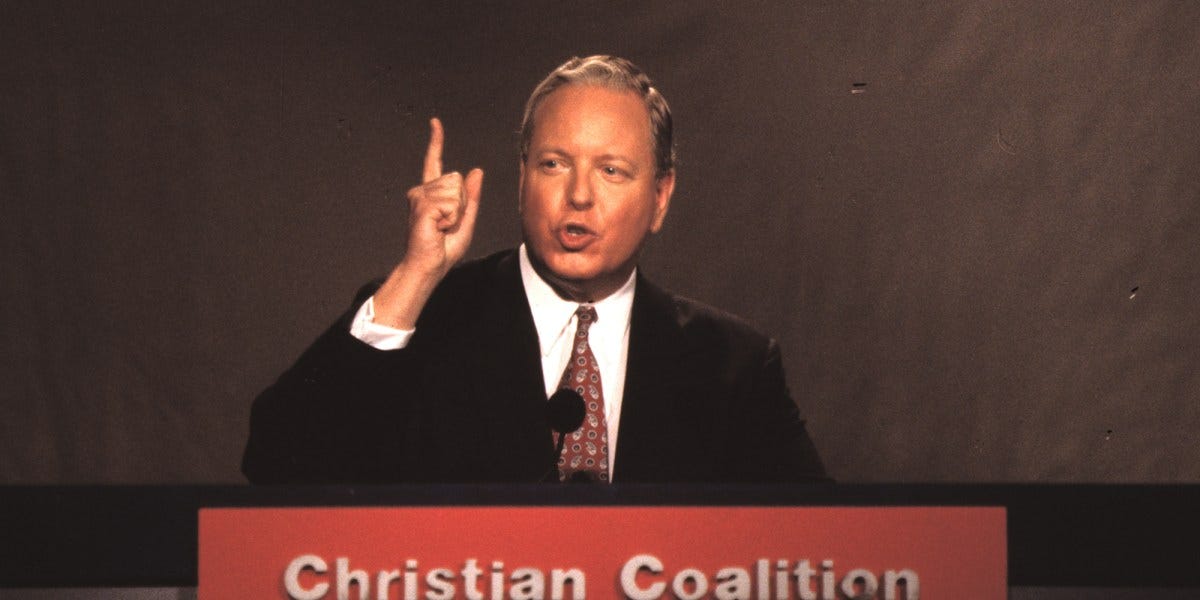
In the 1970s, Christian lobbyists started freaking out. Why? Because they saw that Christianity was giving way to secularism and civil rights in America at an alarming rate. While roughly 90% of Americans were Christian at the time, the cultural dominance of the faith was eroding—banned school prayer, the teaching of evolution, and the forced desegregation of private religious schools were seen as existential threats.
Terrified by this loss of control, leaders like Paul Weyrich (above) and Jerry Falwell decided that if they couldn’t win the culture, they would use government to maintain influence as long as they could. And so the reuniting of church and state began, with a series of strategic legislative moves like The Chastity Act in 1981 and The Equal Access Act in 1984, leading up to the modern day private school voucher program.
The False Promise To Parents
To be clear, the parents utilizing these vouchers aren’t villains; they’re consumers navigating a marketplace filled with false advertising. Most parents want the best for their children: a safe environment, moral alignment with their faith, and a superior education. The tragedy is that the voucher movement exploits this desire by selling the myth that “Private” automatically means “Better.”
Culturally, we assume private schools are elite institutions. Parents enroll their children believing they’re securing a “Harvard-track” education with Christian values. In reality, they’re often placing them in unaccredited institutions that prioritize theological insulation over academic competitiveness.
These families aren’t choosing bad schools on purpose; they’re trusting a system that has intentionally removed the guardrails of accountability. They’re being promised the best of both worlds, but the state knows it’s only delivering one.
Comparing Academic Performance: Public vs. Private
In practice, there are two primary ways to quantify the effectiveness of a private school voucher program: test scores and graduation rates.
When comparing the two, graduating high school is arguably the more critical metric for long-term quality of life. With the exception of skilled trades, a degree is often the baseline for a living wage. Proponents correctly point out that states with private school choice programs often exhibit higher graduation rates.
However, comparing graduation rates between public and private schools is fraught with issues. In the public system, a diploma represents a standardized set of state-mandated requirements. Private schools, by contrast, possess significant autonomy over their graduation criteria. Because they’re not bound by the same state regulations, a higher graduation rate in a private school may simply reflect different standards rather than superior education. If there’s no universal benchmark for what “graduated” means, the diploma itself becomes a difficult metric for comparison.
So that only leaves test scores for comparison. Still, you might be thinking: “Well, if private schools aren’t teaching courses to standardized tests that public schools are required to take, then students at private schools will perform worse on those tests because they weren’t studying the right material. So test scores aren’t good metrics to compare either!” I’d agree with you on that. However, that doesn’t explain away the lack of effects of private schools when comparing more rudimentary tests, like basic mathematics or reading skills. Indeed, a meta-analysis over several studies of private school voucher programs in the U.S. showed gains around 0.05 SD (standard deviations) in reading or mathematics in private relative to public schools, which sounds like a win. However, a SD of +0.05 in the world of education research amounts to 4-5 weeks of additional learning, using the CREDO estimation of ~5.8 days learning/0.01 SD difference. Not significant enough to warrant billions of taxpayer dollars and legislative reform. Moreover, although it’s rare, there’s only one state so far that requires private schools to take state exams, such that the curricula are aligned. That state is Indiana, where students underperformed in mathematics by 0.15 SD, which is equivalent to a loss of 4-5 months of learning. So, if the state’s motive for voucher programs was truly educational excellence, then the case is very weak.
Comparing Equality: Public vs. Private
In a previous article, I discussed the issue of inequality in our public school system due to differences in local property tax revenue. Unfortunately, private schools are just as inequitable, but manifesting in different ways:
Religious private schools legally can, and do, discriminate in admitting students based on the student’s or parent’s sexual orientation or disabilities.
Perhaps most importantly, vouchers are typically not sufficient to cover the full tuition of high-quality private schools. This creates a two-tiered system: wealthy families use vouchers as a "coupon" to offset the cost of elite private schools, while low-income families are relegated to lower-quality "sub-prime" private schools that rely entirely on the voucher revenue. The result is not equality; it’s a state-sponsored caste system.
From The Taxpayer’s Perspective
Financially, these programs are a disaster in the making. Proponents claim vouchers save money because private tuition is often cheaper than per-student public spending. But that math only works if the students switch from public to private schools. The reality is that most voucher recipients were already in private school, meaning the state is suddenly paying for something families were previously buying themselves.
This is what economists call “deadweight loss,” but you can just call it a handout. A 2025 national analysis found that despite the massive expansion of voucher eligibility, private school enrollment has remained virtually flat—implying the money didn’t move kids out of public schools, but simply subsidized those already in private ones. Without a massive exodus from public schools—which capacity limits make unlikely—the “savings” never materialize
In the first year of Arkansas’s universal program, 95% of the funding went to students who were already in private school and simply took the state check as a bonus.
Similarly, in Arizona, estimates found that 80% of applicants were already outside the public school system.
This creates a system that is fiscally regressive. We are effectively draining billions from the public coffers to subsidize the private choices of wealthier families, while the “savings” from students leaving public schools fail to materialize.
Say No To Voucher Programs, And Say No To Religion In Politics
I hope that I’ve made a convincing case for why voucher programs cause more pain than they’re worth, and further entangle church and state, to our detriment. Despite these political plays by Christian lobbyists to maintain Christian influence in America, the percentage of self-identified Christians today has dropped to around 60%.
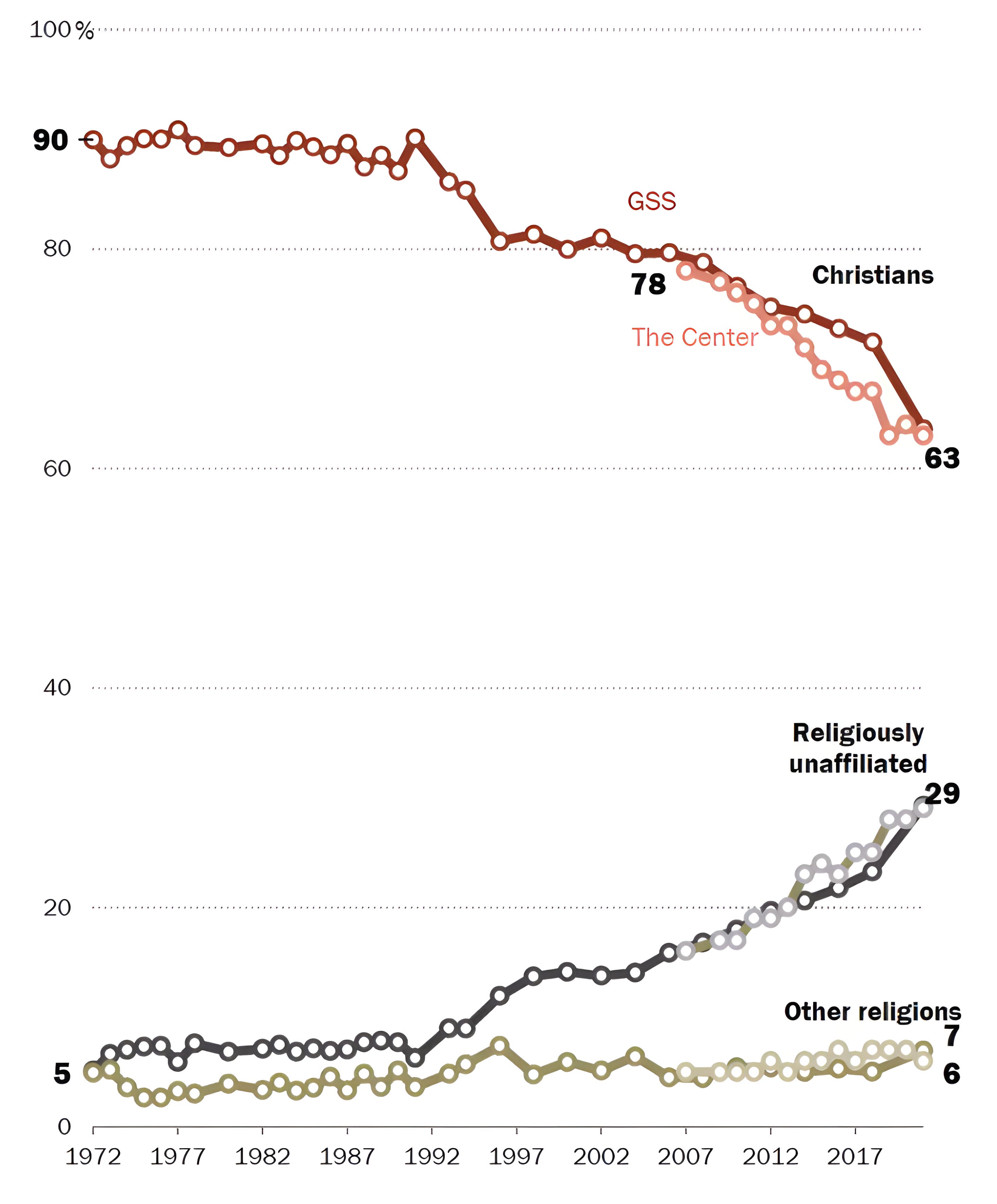
What’s more, it’s predicted that that number will be less than 50% by 2070, which we can be excited about from a political standpoint. This is because with secularism comes progress in the democratic experiment. They’re correlated. The more secular our country is, the more willing we’ll be to vote for representatives that will reestablish the separation of church and state, and once again prioritize evidence-based governance over religious dogma, for the good of everyone.
If you enjoy deep dives like this into progressive political topics, consider liking and subscribing for more. As always, any critiques to any of the points made here are welcomed. Thanks for reading.