
The Outdated Law Responsible For Our Failing Public School System
In this article, I discuss a law first introduced by the Massachusetts Bay Colonists which still dictates public school funding to this day, and in an incredibly unequitable fashion.

Out of the 195 countries globally, we in America are 1 of 99 that legally guarantee K-12 education to its children. It’s a wonderful thing. Problem is, schools are only as good as the amount of funding they have, and here we fund our schools largely by local property taxes. I aim to show how stupid that funding mechanism is in this article. And similar to many stupid laws we still follow today, it should come as no surprise that this law’s origins reach all the way back to the 1600s, with the Massachusetts Bay colonists.
The Origins of Property Tax-Funded Public Schools
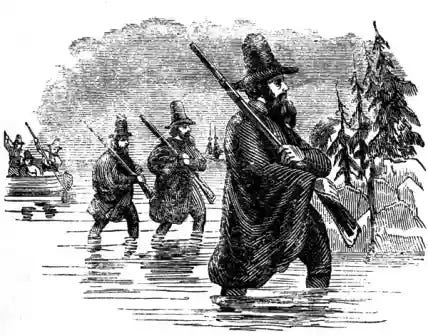
The colonists who settled in Massachusetts Bay were called the Puritans, and were English protestants. They realized that teaching the current and future members of the colony how to read the bible was essential to maintaining a society grounded in Christian values. Thus, The Old Deluder Satan Law was passed, which stated that all towns with 50 or more households must “forthwith appoint one within their town to teach all such children as shall resort to him to read and write” and that they would be paid by “either the Parents or Masters of such children, or by the Inhabitants in general”, in the form of a tax on their property, land, or livestock. It was thought that education of the colony’s children was a moral obligation of everyone in the commonwealth to uphold.
Property Tax Funding of Public Schools Causes Education Inequality
Fast forward to modern day America, where nearly every state still follows this law to fund a significant portion of their school’s budgets. As a result, a child can have a drastically different school experience depending on the state they’re raised in. To show this, I pulled some data from the 2023 Census on public school financing and enrollment. Quick aside, the U.S. Census Bureau is one of the greatest data collection projects in America ever, and I’m extremely grateful to everyone involved in making this data available to the public.
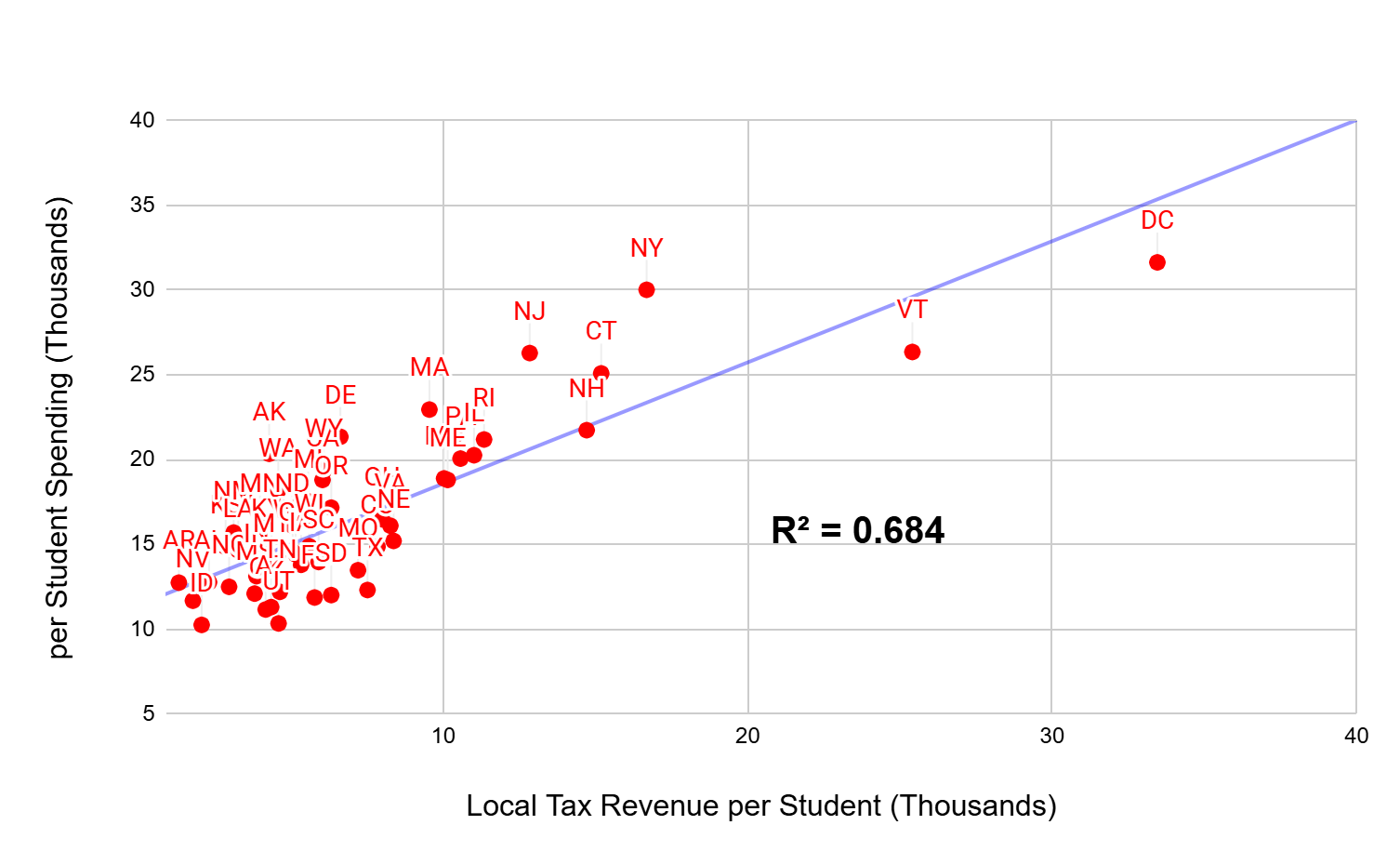
To make comparisons between states, we have to do a little data cleaning on the X-axis. In the Census data, local funding masquerades under two different titles: “property tax revenue” (if collected directly by the school district) or “parental government contributions” (if collected by the city or county government on the school’s behalf). Since both are functionally just property taxes, I summed them up to create a single “Local Tax Revenue” metric and divided by student enrollment to get a per-student figure.
The Y-axis is more straightforward but important to define. I used the Census’s official “Total Current Spending per Pupil” (PPCSTOT). Crucially, this figure includes spending from all sources—federal, state, and local combined. This is important because it allows us to see the actual total resources available to each child, regardless of where the check came from.
So this data suggests that Jane Doe should be concerned that her daughter is going to have a shittier school in say, Missouri, compared to New Jersey. But it doesn’t stop there. As you may have guessed already, inequality of education goes deeper than at the state level. Sticking with New Jersey and Missouri for the moment, let’s zoom in to spending at the school district level for each state in 2023.
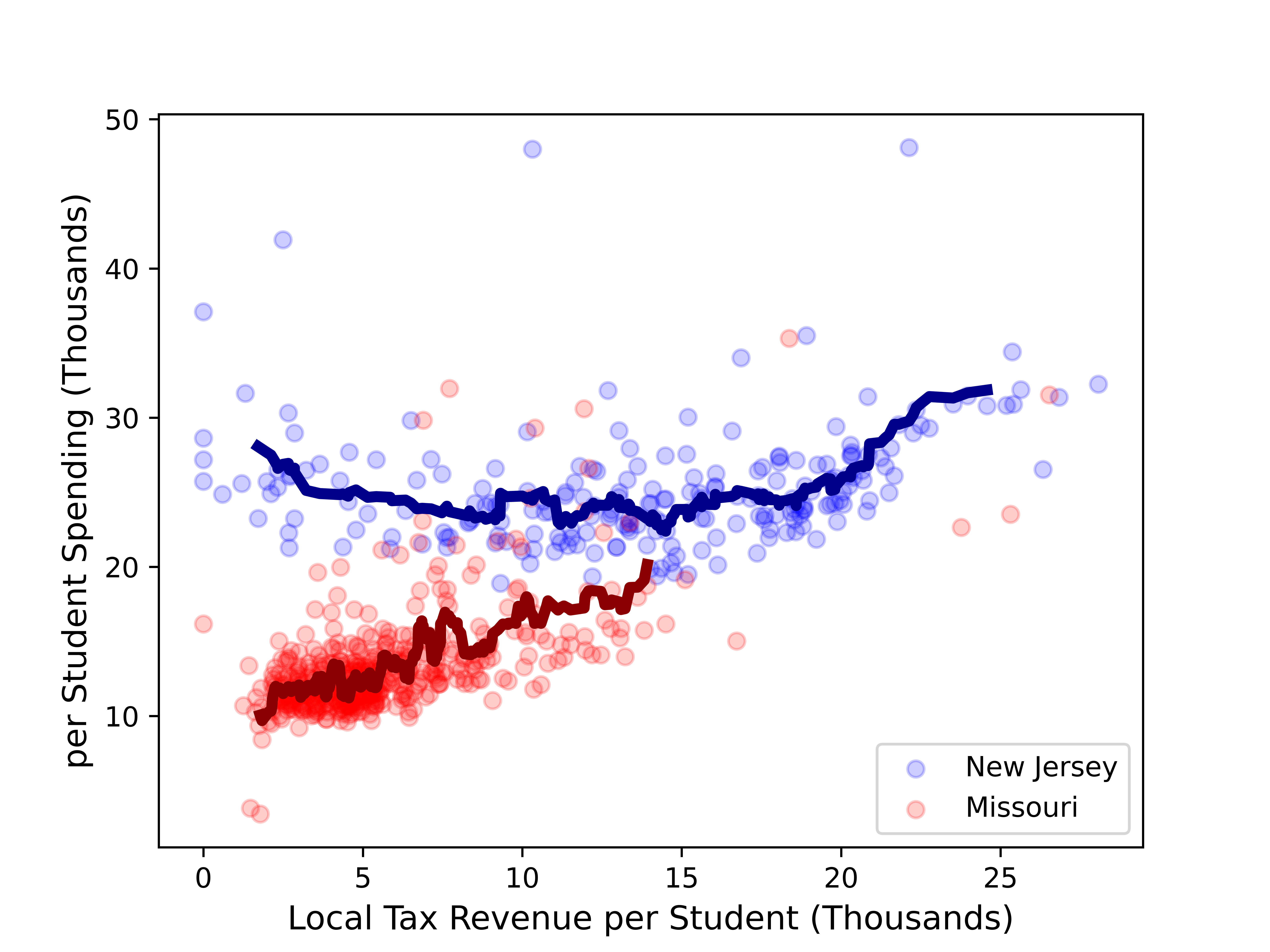
In Missouri, we see the same trend as the national map: children in towns with lower property values are doomed to underfunded schools—unless Walmart decides to build a distribution center there and bolster the tax base. I wouldn’t bet on it.
However, when looking at the data, we have to watch out for the ‘Tiny District Effect.’ Some small districts appear to be spending a fortune per student, but it’s an illusion caused by fixed costs. Think of it this way: Every district needs a superintendent. If a superintendent earns $100,000 in a district with 1,000 students, that costs $100 per child. In a tiny district with only 5 students, that same salary costs $20,000 per child. The Census reports this as ‘higher spending,’ but that money isn’t buying better books or AP classes; it’s just overhead.
In contrast, the New Jersey data looks more like a hockey stick rather than a straight line with a positive slope. This is because the New Jersey state government contributes significantly to fill the gap in poorer areas, so that the spending floor per student is much higher, in tandem with the middle class. Although this means higher state taxes for New Jerseyans, I don’t think it’s a terrible burden to bare so that every kid is guaranteed a decent education.
Finally, I am particularly fond of what Vermont is doing, as you can see they have the highest per student spending of any state, and I think it’s worth mentioning how they maintain that rank every year. Although Vermont like every other state still fundamentally funds their public schools via property taxes, Vermont came up with a glorious way to level the playing field for every child, called the “Robin Hood” system. As you may know, Vermont is a popular destination for skiers and snowboarders, which by many is considered a rich person’s hobby. These ski towns have very few, or no schools at all, yet they bring in a relatively massive amount of property tax revenue. Vermont decided that that surplus property tax revenue is better spent in the poorer towns, so they decided to pool all of it across the state and divy it out to each district according to their student demand. Absolutely beautiful.
However, it’s important to note that Vermont isn’t the only state to do this; places like Texas have similar “recapture” laws. But the difference is in the execution. While Texas often uses recaptured funds to offset state costs (keeping the overall spending bar low), Vermont uses it to aggressively raise the floor.
Looking Forward
So, clearly using local property tax revenue to fund schools is a very unequal, and therefore stupid, way to fund public schools. So what’s the solution? On one hand, there’s the option to maintain the fundamental mechanism of school funding via property taxes, where you find a way to address the inherent inequality like New Jersey (state taxes pick up the tab) or Vermont (redistribution of property tax revenue from rich communities to poor ones). On the other hand, we could just remove the law altogether, and replace it with a fully state-funded public school system. In this scenario, it would operate similarly to Vermont, where the state tax revenue for education is still allocated to schools based on their student demand, but the tax just comes out of everyone’s paycheck instead of a property tax.
The point is, education is our only real defense against tribalism. When we fund schools via property taxes, we are systematically underfunding the very rural and poor areas that are most susceptible to populist rhetoric. We are effectively underfunding the critical thinking skills required to see through a demagogue. By starving these districts, we aren't just failing to buy books; we are creating a vacuum of opportunity that is easily filled by anger and resentment.
Donald Drumpf is the most destructive, undemocratic president in modern American history, and he thrives off controlling the narrative by lying and attacking sources of truth that criticize him. Every president has done this to some extent, but none more than him. Not even close. My hope is that this data shifts how you approach the ballot box. If we vote for candidates who follow the New Jersey and Vermont models, we won't just be funding schools—we’ll be arming the next generation against tribalism and inoculating our country against the next fascist.
Google sheet for the first plot
Github repo for the second plot