
Don't Say "Climate Change"
Looking at solar output over the last decade suggests that green energy isn't limited to Blue states, despite what conservative politicians want you to think.

Most Americans are sick of being forced to pay more for gas because of never-ending wars in the Middle East, and want to transition to clean, renewable energy (although that opinion has regressed amongst conservatives due to the rise of MAGA). These realities together have motivated the deployment of residential and utility-scale solar across the US at an impressive rate in recent years.
When we compare the two parties, we’ve been led to believe that Democrats (and by extension Blue states) typically support environmental policy and green energy initiatives compared to Red states. However, I wanted to see if this is actually true in regards to solar specifically, looking back over the last decade. To do this, I’m going to pull from the Energy Information Administration Database, specifically the EIA-923, which monitors utility-scale solar output for every state on an annual basis. We’ll look at data from 2014-2024, since 2024 is the most recently available finalized dataset. Residential solar is equally important, but will require a different dataset, so I’ll save that for a future article.
And before we get into the data, a quick note on the units for solar output. Like any other source of energy supplying the grid, solar output is measured in Gigawatt-hours (GWh), which represents the total volume of energy generated over the year. For scale, generating 1 GWh is enough to power roughly 100 average American homes for a year.
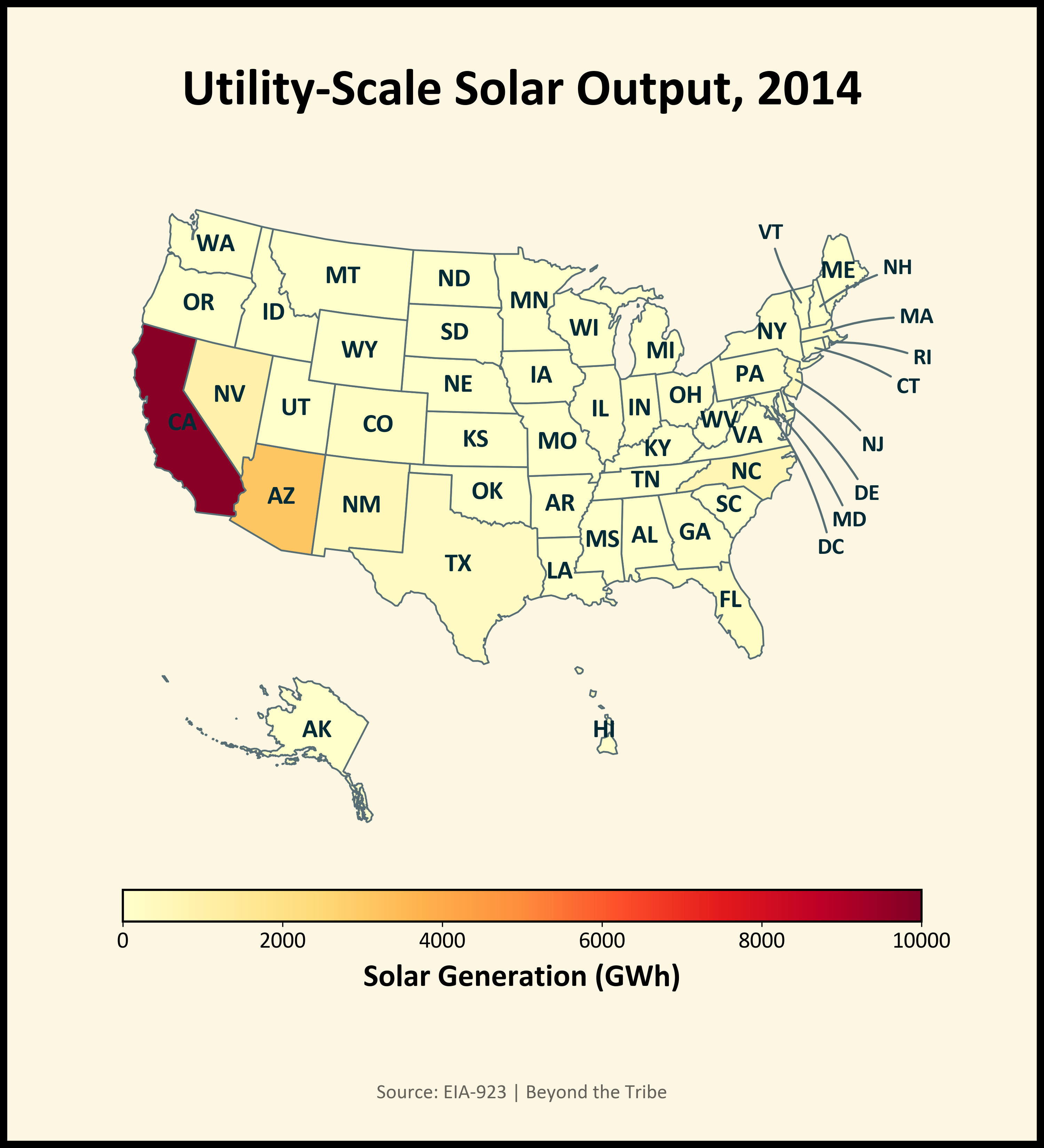
To get an idea of how solar deployment has changed over the last decade, let’s start by looking back at 2014. The map above shows exactly what you’d expect: California, arguably the bluest state in the US, absolutely dominated the solar market with an output of ~10,000 GWh.
This reality fueled a decade of right-wing media framing. Conservative news outlets and pundits have spent years pointing at California as the poster child for expensive, unreliable wind and solar initiatives while dismissing climate change as a hoax. But what if all that conservative bluster was just a smokescreen? What if, while puffing their chests on TV, Red states have been secretly following California’s lead?
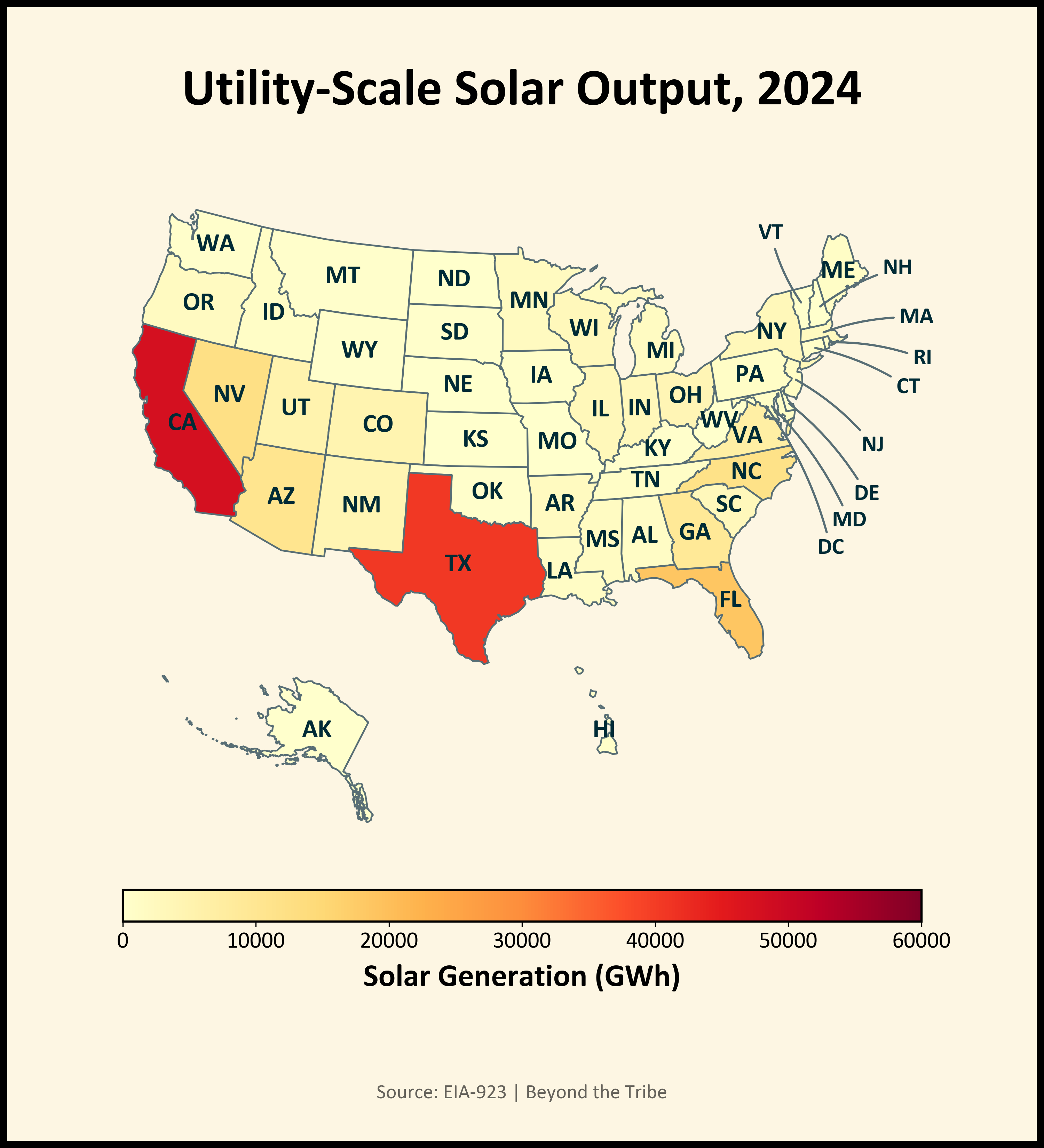
Fast forward ten years, and Texas—one of the most solidly Republican states since the 1980s—has nearly caught up to California. This is particularly impressive considering that California quadrupled its solar output from 2014-2024 (note the color bar scale).
What makes this so wild is that Texas leaders routinely bash the very grid they’re building. After the tragic 2021 winter blackouts that left several dead from extreme cold, Governor Greg Abbott famously went on television to falsely insist that renewable energy was mainly to blame. Yet, quietly, the Lone Star State’s solar fleet keeps growing at breakneck speed.
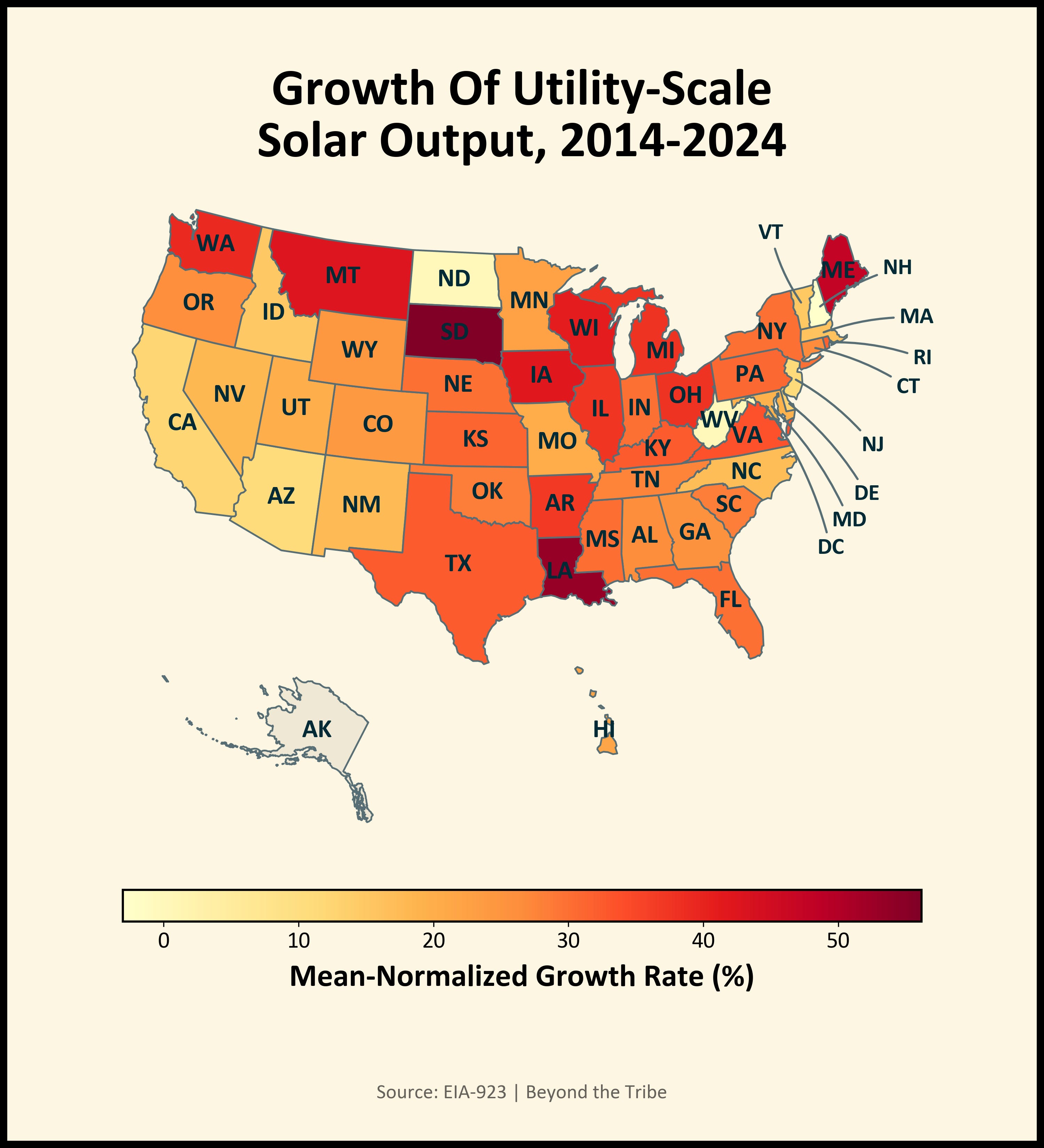
While it’s important to compare changes in absolute output, the heavyweights don’t tell the whole story. If we want to see who is truly accelerating the solar transition, we have to look at momentum. That is, how is a state doing relative to its own output? To figure out who is pivoting the hardest, we can calculate a “Mean-Normalized Growth Rate”, shown above, which is the average amount that a state’s solar output grew every year from 2014-2024, expressed as a percentage of the average output over that 10-year period.
Comparing growth rate shows that some of the reddest states in the US are rapidly building out their solar fleets, totally ignoring the rhetoric of their representatives in Congress.
Take Louisiana. It’s home to House Speaker Mike Johnson, a Republican politician fiercely loyal to fossil fuels and an outspoken conservative voice for over a decade. Yet, Louisiana’s solar growth is exploding relative to its past, driven by massive projects like Oxbow Solar 1 and the Oak Ridge Solar Farm. They realized that solar is simply a massive cost-saver compared to fossil fuels.
(Note: Alaska is excluded here because it started from essentially zero and only reported data for four years, creating a massive, skewed growth percentage that would break the visual scale for the other states.)
Someone Had To Lead By Example
While states like Louisiana and Texas are currently driving the fastest growth, they are building on a foundation de-risked by early adopters. To put it in perspective, California has deployed a whopping 949 utility-scale solar farms across the state as of May 2026, and is in the process of building a new solar farm in San Bernardino County, adding another 1.2 GWh to the grid.
Conservative politicians haven’t wasted any time criticizing California over the years for its widespread adoption of wind and solar. Usually, the main argument is that they’re unreliable sources of energy and needlessly add to an already massive tax burden for Californians relative to other states. High cost of living aside, what that stance conveniently neglects is the effect of any state taking leadership like this. It’s easy to criticize the outsider trying something new, even if the decision was backed by a vast number of economic, materials science, and environmental experts. But once the receipts start piling up: mitigating environmental damage, saving costs, and providing an emergency power source during natural disasters, red states secretly fall in line while pretending otherwise on Fox News.
Ultimately, the fact that states are starting to transition to a greener grid is a net win for the planet and everyone on it, and pretending otherwise so that lobbyists keep funding your reelection campaign isn’t good for Americans.
Thanks so much for reading. Like and/or subscribe for more from Beyond the Tribe.